What the Machine Kept
A sidebar to Divide by Zero, by Roberto Mas
On Friday, 30 October 2026, a Raspberry Pi Pico sat on a desk, tethered by a USB cable to an old Sony VAIO whose internal clock still believed the date was 17 August 2025. The laptop could finish in seconds a calculation that took the little microcontroller board more than eleven minutes. Speed was not the reason to connect them. In 1994, Thomas Nicely found the flaw in Intel’s Pentium by comparing duplicated calculations of prime reciprocals across Pentium and 486 machines. The sums had parted company. The Pico was there to be the second machine. What mattered was whether two very different pieces of silicon, given the same rulebook, arrived at the exact same stored bytes.
The rulebook was the one from our earlier experiment, “The Floor Beneath the Instability,” which belongs to the mathematics Alan Turing took up in Manchester in the last years of his life: how a uniform soup of chemicals can spontaneously break into spots and stripes. Our world was a periodic grid of 64 by 64 cells containing two substances, an activator and an inhibitor, governed by the equations Alfred Gierer and Hans Meinhardt wrote down in 1972. For this new comparison we built a specified harness around the preserved solver: we started the grid smooth and nearly flat, nudged the activator with a tiny Gaussian hill three cells wide and three hundred binary32 floating-point notches high, and told the clock to advance in steps of about 0.0249 time units. Linear analysis makes a straightforward promise about this setup: the disturbance is unstable. A spatial wave should catch hold and grow.
In the ordinary calculation, it did not grow. After 115 updates, model time 2.864, the wave had settled to 0.971 of its initial amplitude and stopped dead. The 115th update left every stored value for the activator and inhibitor unchanged. The Pico stopped there, and an additional reference check confirmed persistence: repeating the autonomous rule would return the exact same state again. The simulation had found a fixed point of its own numerical rule.
On the USS Yorktown, a zero entered during a fuel-valve calibration led to an engineering network failure and loss of propulsion control. On Ariane 5’s first flight, the failure of both inertial reference systems cost the launcher its guidance; it broke up about forty seconds after the ignition sequence began. Here, nothing crashed. No nonfinite value or arithmetic failure was reported, and no NaN was printed to the screen. The silence of the frozen grid looked like a physical system that had found its equilibrium.
The differential equations had supplied an instability. The machine’s arithmetic had supplied a stopping place.
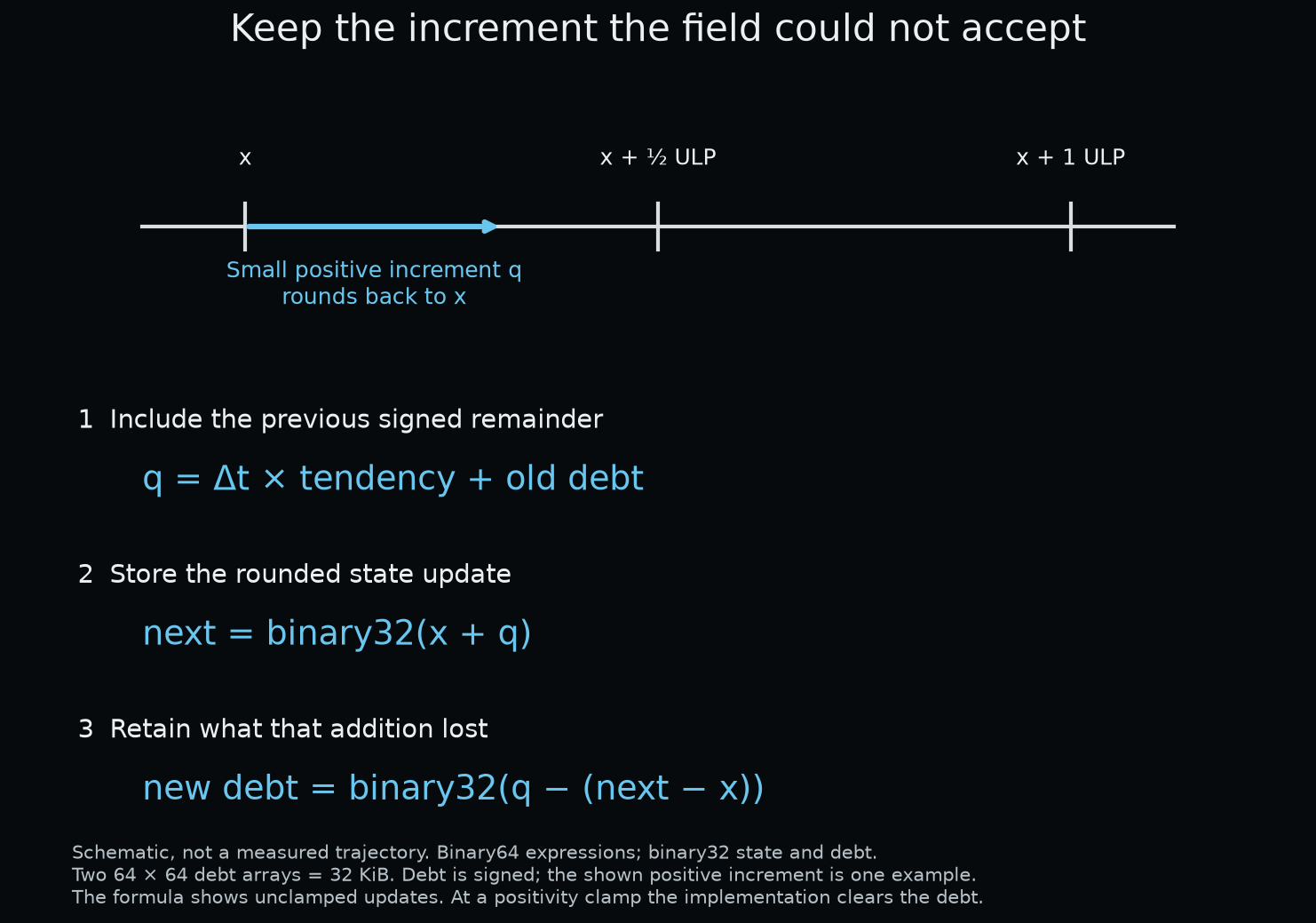
The update’s information ledger. Schematic; one positive increment is shown. Two binary32 correction arrays occupy 32 KiB.
The companion
Both the laptop and the Pico already evaluated expressions in 64-bit precision (binary64), while storing the fields and Laplacians in 32 bits (binary32). Wider expressions did not prevent stagnation. The intervention we tested addressed one particular loss: the increment discarded when the state update was rounded back into a binary32 field.
A small change is easy to hold by itself and impossible to add to a much larger number when the grid must round the sum to the nearest available 32-bit slot. When the requested change falls narrower than half the gap between two representable numbers, the addition chooses the old number and throws the change away. William Kahan joined the IEEE p754 working group at its second meeting in November 1977. He and his colleagues fought for gradual underflow, against the practice of flushing tiny results directly to zero. The committee’s altruism so astonished Cleve Moler that he compared its meetings to the Grand Canyon. Our reaction-diffusion grid was suffering the cousin of that disease: not an underflow to zero, but additions drowned out by the numbers they were trying to move.
Twelve years before those committee meetings, in 1965, Kahan had published a remedy for lost increments. Our update belongs to the established family of compensated calculations. If the main variable cannot hold the change, give it a companion.
We gave every cell in the 64-by-64 grid two 32-bit companions, one for the activator and one for the inhibitor. Together they cost 32,768 bytes of memory, the exact weight of the ledger needed to balance the books. After each update, the program looked at the change it had tried to add, subtracted the change the 32-bit field had actually accepted, and wrote the lost remainder into the companion. At the next state update, after computing the new tendency, it folded that signed remainder into the new increment. Fractions that would have been swept onto the floor could now accumulate in the companion until they were finally big enough to push the main field across a rounding boundary.
On the RP2040 Pico, running at 125 megahertz, the compensated run took eleven minutes and twenty-seven seconds. It did not freeze at step 115. It marched through all 2,410 requested updates to reach model time 60.015. Measured across both species, the unstable spatial wave had grown by a factor of 9.648. A full 64-bit reference calculation gave 9.662.
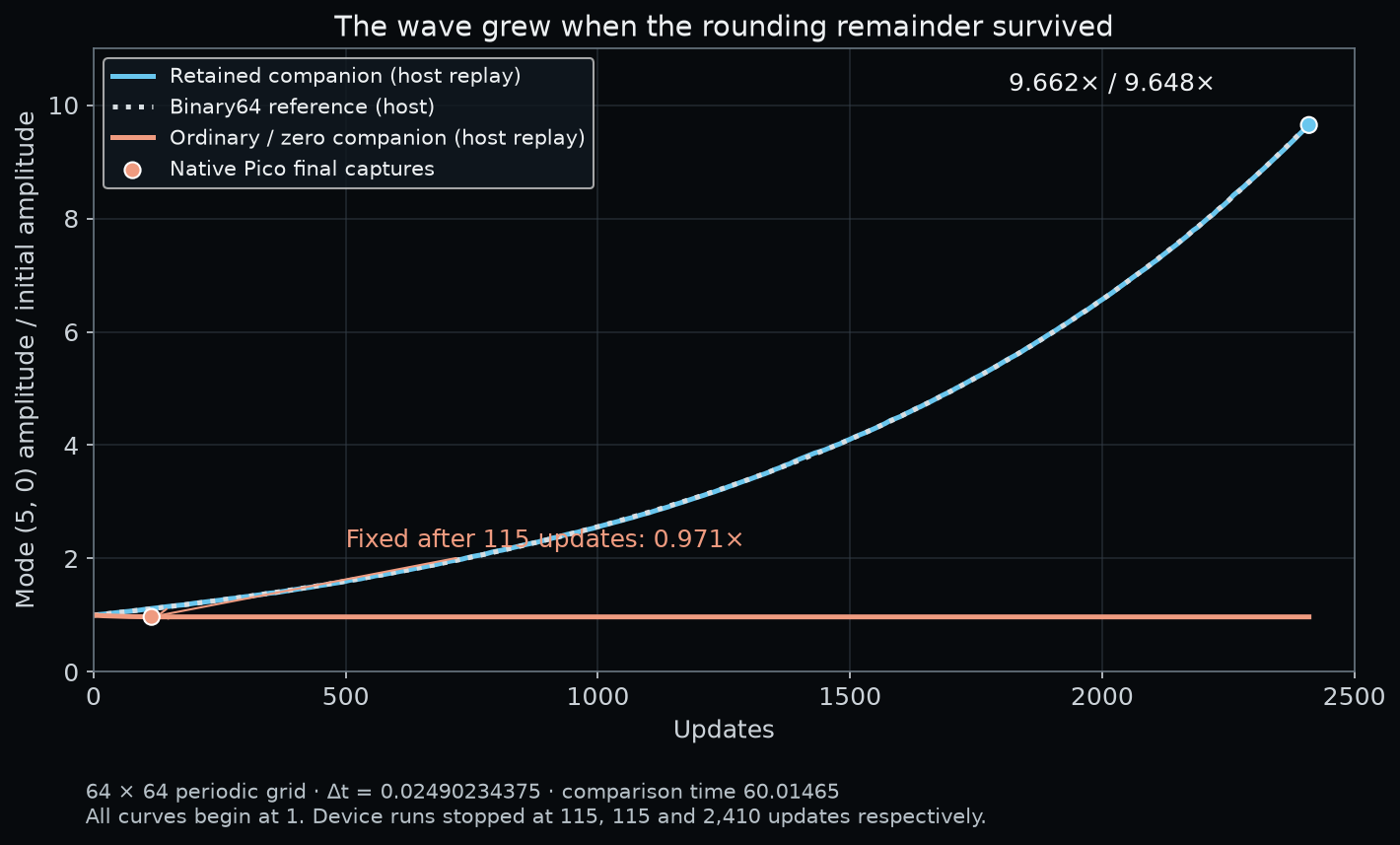
Lines are a new host replay whose complete final hashes match the captured states. Dots mark native Pico final captures; they are not a device time series.
Better still, Nicely’s check held. At the end of the run, every single byte of the Pico’s final fields and remainder arrays matched the Sony VAIO’s calculation at the same step. Compared against the 64-bit reference, the recovered pattern had a relative spatial error of 0.66 percent in the activator and 2.62 percent in the inhibitor. By keeping a ledger of what the rounding threw away, the calculation kept its fields in binary32 while closely tracking the binary64 reference.
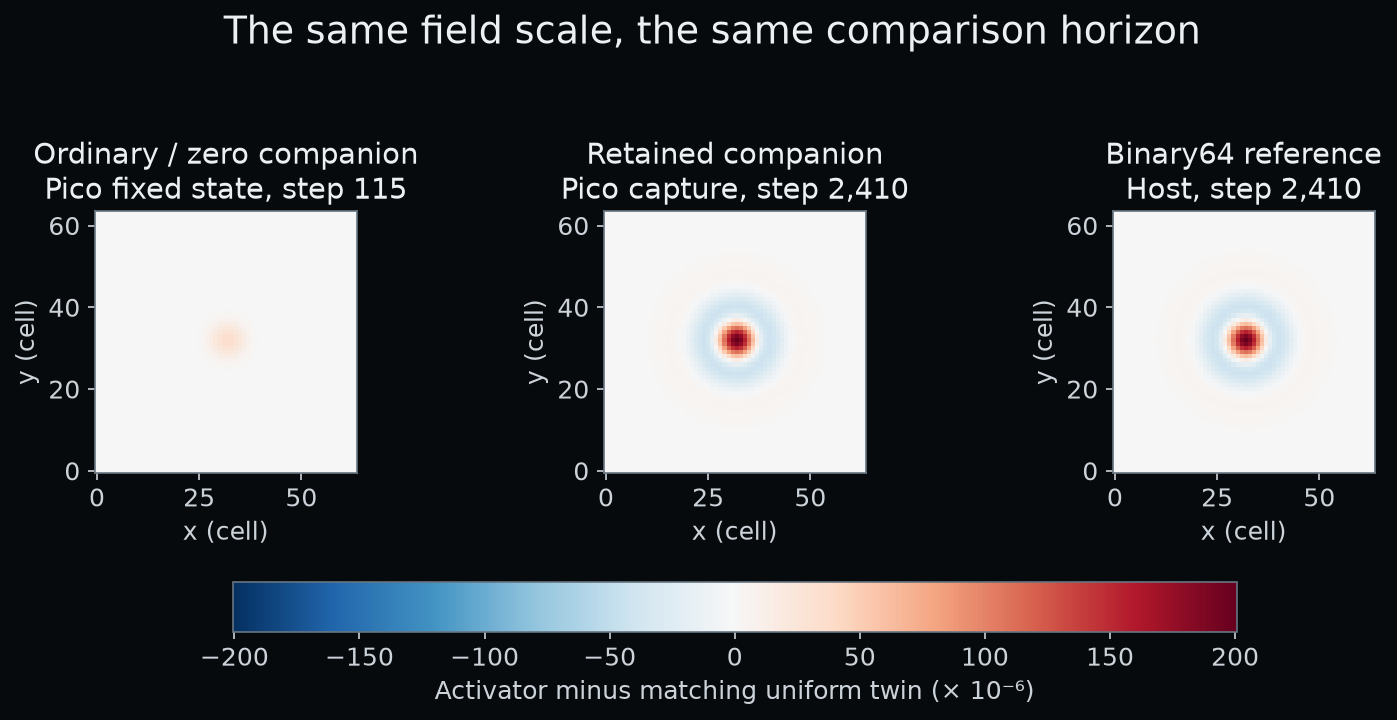
Activator minus its matching uniform twin, in millionths. Ordinary and zero-companion states stop at update 115; the retained run reaches update 2,410. These are small disturbances, not mature nonlinear spots.
The control
A remedy in experimental science needs a control of its own. All three modes in our test firmware allocated the exact same 32,768 bytes of companion buffers so the memory layout never shifted. We also ran a mode that kept the companion arrays at zero. It reached the same numerical fixed point after the same 115 steps. The version that retained corrections recovered growth close to the wider reference; the version with no correction carried forward reproduced the freeze.
Here the shelves of Divide by Zero meet on one small board. An explicit Euler step that stores a rounded sum and keeps no account of the remainder can make a numerical barrier look like an unresolved fact about the model: the program runs without an ERROR, the books fail to balance by less than half a unit in the last place, and the simulation quietly substitutes a rule of silicon for a law of nature. We knew to question the quiet answer because a calculation that carried more information disagreed with it. This is a tested numerical remedy for this fixture, not a proof that either numerical calculation exactly solves the continuous equations.
The standard applied
Following the rule set out in the Coda of Divide by Zero, the edge of this hole can be stated plainly:
What is unknown. Whether a quiet, steady numerical field reflects the true equilibrium of the modeled equations or the stagnation of an update rule that has lost its increments.
Which framework makes it unknown. An explicit time-stepping scheme in finite precision that rounds each state update to the nearest representable value and carries no account of the sub-ulp remainder.
What changed the judgment. Retaining 32,768 bytes of rounding remainders across steps restored unstable wave growth (9.648x versus the binary64 reference’s 9.662x); the mode with the companion arrays kept at zero reproduced the 115-step freeze byte for byte.
Status, 30 October 2026. Verified for this fixture, these arithmetic policies and the stated horizons. Native compiled C++ on an ARM Cortex-M0+ (RP2040 Pico) and Node/V8 controls on an x86-64 Intel i5-3320M (Sony VAIO) achieved complete byte-level parity across all fields and companion arrays at matched steps.
The Pico and the VAIO have told this part of their story. Our next findings will come from running these controlled experiments on an AMD Ryzen AI Max+ 395 system with 128 gigabytes of memory. We will carry forward the same serialized starting fields, explicit arithmetic policies and byte-level ledgers. A different processor and more working memory will give us room to examine more cases, preserve more of their histories, and test where the map and the territory part ways again. Agreement will still have to be measured.
Notes on the sources
Recovery evidence was acquired and independently validated on 30 October 2026. The VAIO’s wall clock reported 17 August 2025; the acquisition and original device logs preserve both dates. Run durations use the Pico’s monotonic timer. A public evidence record includes parameters, measured horizons, complete-state SHA-256 hashes, relative errors and links by filename to the captured arrays. The host replay supplies the plotted curves; it is not device telemetry.
The system is Gierer–Meinhardt on a 64 × 64 periodic grid, with a nine-point Laplacian and explicit Euler stepping: Δt = 0.02490234375; production 0.1, activator decay 0.08, inhibitor decay 0.12, basal source 0.002, no saturation; diffusion coefficients 0.08 and 3.2. Historical standalone scripts exp4.js and exp6.js were unavailable. This is a new specified harness with the preserved solver and newly specified, serialized Gaussian starting fields: activator-only, width 3 cells, peak height 300 binary32 ULPs. It does not independently recover the original experiment’s complete provenance.
All three policies use binary64 expressions with binary32 fields and Laplacian buffers. The same firmware allocates the same six arrays in all modes. Two correction arrays account for 32,768 bytes of the 98,304-byte state. The zero-correction branch assigns zero without executing the remainder subtraction. An earlier draft overstated that control as compute-then-discard; no matched-work compute-then-discard experiment was run.
The longer Pico comparison requested 2,410 updates to model time 60.0146484375. Ordinary and zero-companion runs each executed 115 updates, to time 2.86376953125, then stopped at exact complete-state fixed points. Host checks confirmed persistence under the same autonomous rule; later updates were not physically executed on the Pico. The retained-companion run executed all 2,410 updates. None reached its wall cap. The new figure in the earlier sidebar shows this later hardware check, not a recovered 19 October capture.
Growth factors measure the amplitude of Fourier mode (5, 0), projected from both species using the discrete linearized operator’s left eigenvector. They are not peak-height ratios. Relative spatial L2 errors compare each policy’s disturbance from its own unperturbed twin with the binary64 reference disturbance from its matching twin. Agreement with a finite numerical reference does not establish physical stability or exact continuous dynamics.
Hardware: Sony VAIO SVS13A290X, Intel i5-3320M, Windows 10 Home build 19044, Node 24.20.0/V8; native RP2040 Pico at 125 MHz, Arduino-Pico 6.3.1, -O2, -fno-fast-math, -ffp-contract=off. The Pico evaluates binary64 expressions in software. Nine eight-step device checks covered three timesteps and all three policies before the longer single-timestep comparison. Captures include both species and both correction arrays, 65,536 bytes per final device state. The implementations share solver ancestry: byte parity verifies tested execution, not an independent derivation of the physics.
Rounding stagnation and compensated calculation are established subjects. Weimar (1997), section “Schlögl Model” describes spurious steady states and their dependence on timestep in reaction-diffusion computation. Croci and Giles (2020/2022) analyze stagnation and rounding in heat-equation solvers. Paxton and colleagues (2022), section 4 discuss compensated time stepping. Our contribution here is the documented comparison, control and device execution for this specified case, not a new discovery of compensation or stagnation.
Historical checks: Richard Brent’s account of Nicely’s duplicated calculations; the Navy account of Yorktown reprinted in the Congressional Record; ESA’s Ariane 501 inquiry summary; Kahan’s IEEE 754 reminiscences. The underflow history is an analogy; these field updates stagnated through absorption, not underflow.
Next processor: AMD’s Ryzen AI Max+ 395. The owner identifies the next system as the 128 GB configuration. This is system memory, not a claim of 128 GB of dedicated GPU memory; no AMD results are reported here.